
Scent Training for a Pharmacy Own-Label Team: A Step-by-Step Rollout
Scent training for a pharmacy own-label team is not about turning staff into perfumers; it is about making sure everyone describes the same product in the same words. A short, structured rollout works better than a long course: define what the team must be able to say, build a shared vocabulary against real reference materials, calibrate with a blind session, connect the language to the pack and the price, and repeat it every time the range changes. Done that way, training becomes a selling tool rather than a day out of the store.
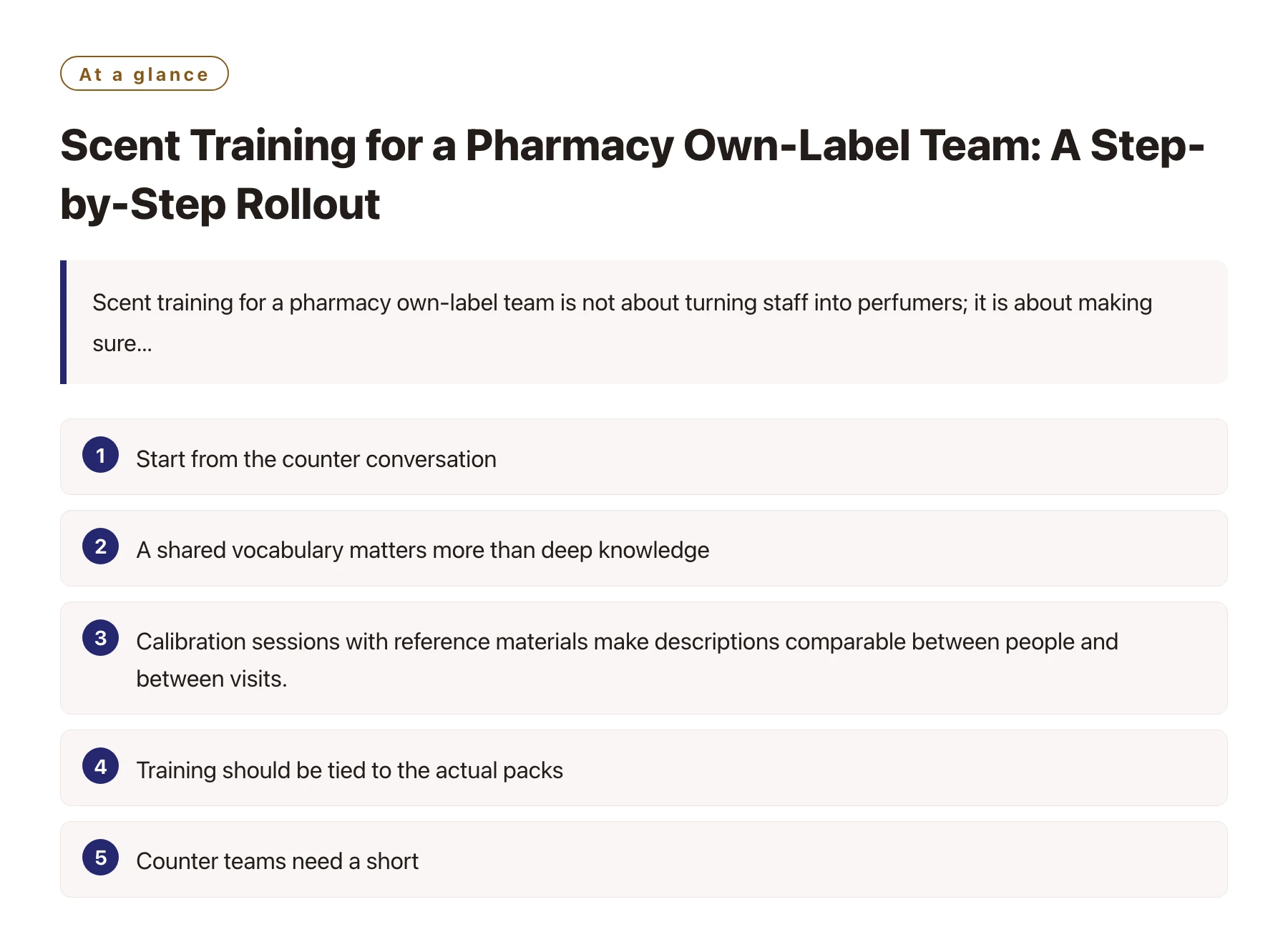
Key takeawaysStart from the counter conversation, not from fragrance theory: what a shopper asks in thirty seconds is the syllabus. · A shared vocabulary matters more than deep knowledge, because inconsistent descriptions create doubt at the shelf. · Calibration sessions with reference materials make descriptions comparable between people and between visits. · Training should be tied to the actual packs, claims and price tiers of the range being sold. · Counter teams need a short, honest answer about strength, longevity and skin sensitivity, plus a clear rule for when to refer a question. · Refreshing the session whenever the range or its documentation changes keeps the training from going stale.
In a pharmacy, fragrance is sold in a conversation. The shopper picks up a bottle, hesitates, and asks the person behind the counter whether it is strong, whether it lasts, and whether it is suitable for sensitive skin. The answer decides the sale more often than the packaging does, and if two staff members give two different answers, the range starts to look uncertain.
Most own-label programmes treat training as an afterthought, arranged once the stock has landed and delivered by whoever is free that morning. That produces enthusiasm without consistency. A structured rollout takes about the same amount of time and produces something the retailer can reuse when new staff join or when the range is extended.
The steps below are written for the person running the programme, usually a brand or category manager working with a manufacturer. They assume no prior perfumery knowledge on the team and no budget for a long course, only a few hours, a set of reference materials and the actual products.
A seven-step rollout that fits around store rotas
- 1. Write down what the team must be able to doList the four or five things a counter conversation actually requires: describe the scent in one sentence, compare it with the neighbouring product, explain strength and expected longevity, answer a basic safety or sensitivity question, and know when to hand the question on. This list is the training plan.
- 2. Split the audience by what they doBuyers and product managers need to read a brief and judge a sample; counter staff need to describe and compare a finished product. Run the sessions separately, because the same material at the same depth bores one group and overwhelms the other.
- 3. Build a shared vocabulary with reference materialsChoose six to ten words the team will actually use, such as citrus, green, floral, woody, amber and clean musk, and pair each with a physical reference. A word nobody has smelled is not vocabulary, it is decoration. Organisations such as the Fragrance Foundation publish material on fragrance appreciation and education that can support this stage. [1]
- 4. Calibrate with a blind sessionBlind-smell the reference set and the actual range, and have each person place the samples in order of intensity and family. The purpose is not to test anyone but to expose how differently people describe the same liquid, which is the problem the training exists to fix.
- 5. Connect the language to the pack and the priceFor each product, agree the one-sentence description, the two adjectives to avoid, and the price tier it belongs to. A description that implies luxury on a value pack creates the wrong expectation and returns.
- 6. Rehearse the hard questionsStrength, longevity, skin sensitivity and safety are the questions that decide confidence. Rehearse short, accurate answers and agree a line for anything outside the team's knowledge. Fragrance safety science, including the work published by the International Fragrance Association on safe use, is a useful grounding for what a safe answer sounds like. [2]
- 7. Repeat and measureRefresh the session when the range changes, when staff change, or once a season. A five-question check at the end of each session tells you whether the vocabulary stuck, and it takes two minutes.
Why calibration beats knowledge
The failure mode in retail scent training is not ignorance, it is variation. One assistant says a scent is fresh, another calls the same product heavy, and the shopper concludes that nobody in the store knows the range. Calibration fixes this by giving the team a common scale and a physical anchor for every word on it, and the fix survives staff turnover if the reference set is kept with the training notes.
A calibration session also gives the brand team something more valuable than confidence: it shows how consumers who are not perfumers divide the range. If the team cannot tell two products apart after a short session, a shopper standing at the shelf for twenty seconds certainly will not, and that is a range architecture problem rather than a training problem.
This is one of the practical uses of a supplier's collection. Walking a curated set with someone who can explain what is being smelled compresses months of casual learning into an afternoon, which is why a visit to the immersive scent museum is a reasonable first session for a new team. The museum supplies context and comparison; the follow-up session in the store supplies the words the counter actually needs.
What not to put in the training
Avoid chemistry, history and material sourcing in a counter session. They are interesting and they do not help anyone sell a body mist. Avoid long lists of notes as well, because a shopper cannot absorb five notes in a short conversation. One clear impression, one comparison and one honest caveat is the working unit.
A half-day agenda that a pharmacy chain can reuse
| Segment | Focus | Output at the end of the session |
|---|---|---|
| Opening (20 minutes) | What the range is for, who buys it, what it competes with on the shelf | A shared reason for the training, not a general introduction |
| Vocabulary and references (40 minutes) | Six to ten agreed words, each with a physical reference | A one-page lexicon that fits on the counter |
| Blind calibration (40 minutes) | Ordering the range by intensity and family | Agreement on where each product sits |
| Product language (40 minutes) | One sentence per product, plus the two adjectives to avoid | Approved descriptions that match the pack claims |
| Hard questions (40 minutes) | Strength, longevity, sensitivity, referral rules | Short answers everyone gives the same way |
| Wrap-up (20 minutes) | Five-question check and a note of what to revisit | A dated record that a new joiners' session can follow |
The agenda is deliberately short. A session the team can attend twice a year beats a two-day course nobody repeats.
Where the manufacturer fits in
A brand team can run steps one to five on its own, but two parts are easier with the supplier involved. The first is the reference set: a manufacturer that develops scent for a living can supply comparable materials and explain the differences plainly. The second is the sample discipline, because the people who will teach the range should have smelled the alternatives that were rejected, not only the one that was chosen.
Where the supplier also runs teaching sessions, the brand can buy a calibrated starting point rather than build one from scratch; a house that maintains a fragrance academy is usually set up to deliver exactly that, in a format that can be repeated for new staff. The practical question to ask is not whether the course is impressive but whether the vocabulary it teaches can be transferred to the counter unchanged.
For ranges produced with a partner that handles fragrance manufacturing under one roof, the same session can double as a project review. The team learns the vocabulary and, at the same time, sees where its brief turned into a formula, which makes the next brief noticeably sharper.
Sources
- The Fragrance Foundation —— A non-profit organisation for the fragrance industry, running perfumery education programmes and industry recognition.
- IFRA: Safe Use and Fragrance Science —— IFRA's explanation of how fragrance materials are scientifically assessed for safe use and how those conclusions are applied by the industry.
Frequently asked questions
How long should scent training take for a pharmacy team?
Half a day is enough for a first rollout covering vocabulary, calibration, product language and the common shopper questions. A short follow-up session each season or whenever the range changes keeps it useful.
Do counter staff need perfumery knowledge to sell own-label fragrance?
No. They need a consistent, honest vocabulary and a clear answer to four common questions. Deep perfumery knowledge is useful for the product team developing the range, not for a short conversation at the shelf.
What should a brand team avoid in a training session?
Chemistry, long note lists and history tend to consume time without improving a sale. Keep the session on what the shopper asks, and keep the lexicon small enough to remember after a busy shift.
Should training happen before or after the range launches?
Before, with the final packs and approved claims if possible. Training on the actual product prevents the descriptions from drifting away from what the label says, which is where compliance problems begin.
How do we know the training worked?
Use a short check at the end and a mystery-shop style comparison a few weeks later. If two staff members describe the same product the same way, the calibration worked; if not, the reference set needs another session.
Stay with us on Rue de l'Université.
Best available rate, confirmed in under one minute — no OTA fees, no comparisons required.