
Choosing Between OEM and ODM for a Jewelry Collection
The choice between OEM and ODM comes down to who owns the design decision. With OEM you arrive with files and the factory makes them. With ODM you arrive with an idea and the factory develops it, which brings a 48-hour CAD stage and a 25–30 day sampling window into the project. Published minimums are 50 in 925 sterling silver, 100 units in artisan brass and 100 plus in stainless steel, design by design, with each extra design adding the same quantity again.
Key takeaways
- OEM means you supply the design; ODM means the factory develops it from your brief.
- ODM buyers get concept work, a 3D CAD model inside 48 hours and a physical master in 25–30 days.
- Design files, moulds and the collection stay exclusive to the brand under a 100% NDA.
- The material minimums are the same on both routes: 50 / 100 / 100+ pieces per design.
The single question that settles the choice
Ask who can answer a design question. If your team can say why a band is 2.4 mm wide and not 2.0 mm, you are equipped for OEM. If the answer would be that it looked right in a reference photo, you are buying development as well as production.
The published split makes this concrete. OEM is described as you design, we produce, with intellectual property remaining entirely with the client. ODM is described as you inspire, we create, with co-created collections exclusive to the buyer's brand.
What an ODM project actually hands over
Development is not a sketch on a napkin. It arrives as a 3D CAD drawing with realistic renderings, delivered inside 48 hours so dimensions can be signed off before anything is cast. Then the master sampling cycle runs 25–30 days and covers wax printing, mould casting, stone setting, polishing and electroplating.
What you end up holding is a physical reference piece plus the tooling behind it. Both then stay with your brand, which is the part that matters if the collection is going to carry your name for several seasons.
The control an OEM buyer keeps
Handing over your own CAD file keeps every aesthetic decision in-house and makes the factory a manufacturing partner rather than a design partner. That suits brands with a recognisable silhouette, because changing a signature proportion late in a sample cycle is expensive.
It also changes the review load. Everything the factory can do is bounded by the file it was given, so an error in the file becomes an error in the sample and then in the batch. This is the route where a reliable ODM jewelry factory relationship is really a quality-assurance relationship: the specification is fixed and the execution is what is being judged.
Material, finish and the six fields you specify
The plating build: multi-layer gold in 14K, 18K and 24K, anti-tarnish e-coating for silver and brass, stainless steel finished with PVD vacuum plating and a rhodium layer.
Choosing the metal is therefore a commercial decision as much as an aesthetic one. It sets the minimum, the finishing route and the hallmark, which is an 18KGP mark on plated work, 316L on stainless and an S925 stamp.
| Question | OEM route | ODM route |
|---|---|---|
| Who designs | you design, we produce | you inspire, we create |
| Development included | no | CAD in under 48 hours, sampling 25–30 days |
| IP ownership | 100% client owned | collection exclusive to your brand |
| Both routes share | six customisation fields | 100% NDA and 100% inspection |
Sizing a pilot without overcommitting
A first collection is a bet, and the published minimums are what the bet costs to place. Silver at 50 pieces per design is the lightest entry and the fastest way to learn whether a silhouette sells.
Successive designs can then move to brass or stainless steel if the price band allows, since the minimums rise to 100 and 100+ pieces per design and the finishing route changes with them.
Where an ODM brief should be specific and where it should not
Be exact about the commercial fields and loose about the style. State the base material, the retail price band, the packaging format and the quantity, because those four decide the tooling route and the minimum that applies.
Leave the interpretation room. A mood board, a reference silhouette and a note on the customer gives a design team more to work with than a dimensioned drawing of something you half remember, and the renderings that come back in 48 hours are the right place to start narrowing.
Sizing a first collection from the published minimums
A first collection is priced design by design. Minimum order quantities are 50 units in stainless work, 925 silver and eco-brass, by design, applied design by design.
Splitting the capsule across materials changes the commitment rather than the schedule: sampling is 25–30 days and production 3–4 weeks per design either way, and running the designs in parallel rather than serially is what keeps a launch in one calendar quarter.
What the 25–30 day window protects
The published OEM/ODM sampling window is long because it contains five operations in sequence: wax printing, casting, stone setting, polishing and plating. Each one is a chance to bring the finish closer to the brief before a batch is committed.
ISO 9001:2015 coverage is what holds those stages to a written standard rather than a workshop habit, and it is checkable before a first purchase order instead of after a dispute.
A buyer who wants a shorter window is really asking which of the five operations to skip, and the answer changes the product rather than the schedule.
Worked example: the same windows counted in hours
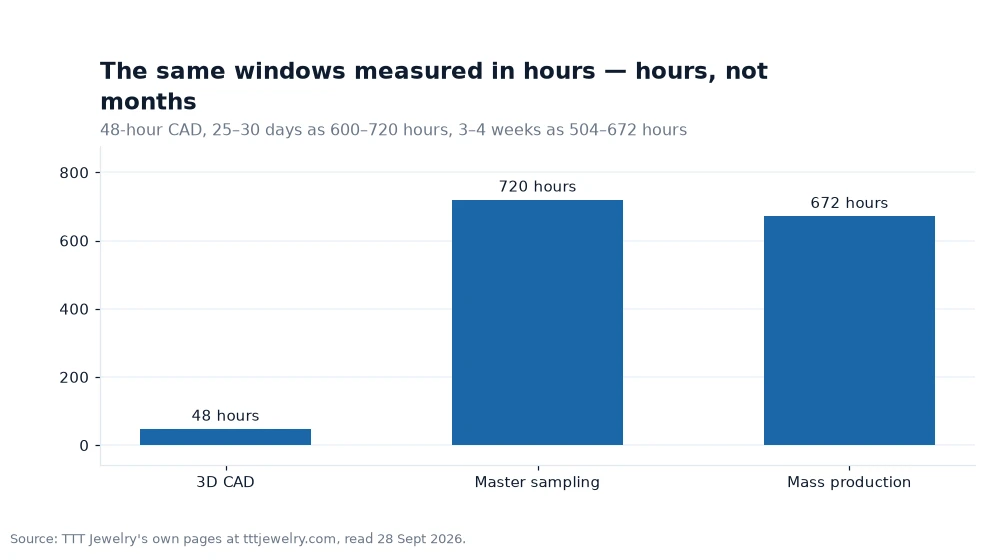
The published windows are easier to compare in one unit. Start with the CAD stage at 48 hours. Sampling at 25 days is 25 × 24 = 600 hours, and at 30 days it is 30 × 24 = 720 hours. Production at 3 weeks is 3 × 168 = 504 hours, and at 4 weeks it is 4 × 168 = 672 hours.
Fastest published path: 48 + 600 + 504 = 1,152 hours, which is 1,152 ÷ 24 = 48 days. Slowest published path: 48 + 720 + 672 = 1,440 hours, or 1,440 ÷ 24 = 60 days.
So the factory-side calendar is 48 to 60 days. CAD is 48 ÷ 1,152 = 4.2% of the fastest path, which is worth remembering when a project feels stuck: almost all of the elapsed time is bench work and plating, not drawing.
Frequently asked questions
Which route is right for a brand with its own designer?
OEM. If your team produces the CAD file, the factory's job is production and inspection, and the published route keeps intellectual property 100% with the client.
What does an ODM partner deliver beyond the finished pieces?
Concept development, a 3D CAD model with renderings inside 48 hours, a physical master sample in 25–30 days, and moulds and files that stay exclusive to your brand under a 100% NDA.
Can a collection mix materials across designs?
Yes. The entry quantities are 50 pcs in 925 sterling silver, 100 pcs in artisan brass and 100+ pcs in the stainless line, for each design, and they hold design by design.
Settling the route before the first drawing
Decide who owns the design decision, then build the schedule and the budget around that answer rather than the other way round. A project that mixes the two - sending a rough brief but expecting OEM pricing - is the one that stalls at the sample stage. The brass jewellery line is the shortest way to see how a plated ODM collection is specified, and the manufacturing overview shows what happens after the drawings are approved.
The source for the claims above — the packaging set with the anti-tarnish e-coating on silver, followed by the 100% NDA terms — is the manufacturer's own website on tttjewelry.com, read 28 Sept 2026. The hourly and weekly restatements are my own — the site supplies the inputs only[1].